Friday, 20 November 2015

Week #10 Reflection

This week in our mathematics course we discussed mean, median , mode and range,   integral concepts which become infused in the everyday lives of an individual. We began by looking at the development and organization of a stem and leaf plot through an estimation activity which involved a jar full of Oreos! I generated my guess by imagining about how many Oeros came in a standard package (48) then visualized the amount of boxes required to fill the jar. I hypothesized about one and a half boxes which would calculate to 72, once the class formulated their estimations we organized the data on a stem and leaf plot. When we input the data onto the graph we were able to calculate the mean, median, mode and range which produced numbers quite similar to the actual amount (106).  This activity was a fun, informative demonstration of how information can be gathered and organized to produce a set of data.

Figure 1
Found under the Statistics tab for students.
 These are more activity based games
 as they work to challenged student thinking
in a fun way
.
For this week I thoroughly enjoyed being introduced to and having the opportunity to explore the website Johnnie's Math Page" as it had an abundant amount of activities available for both students and teachers. This website was unlike any other we have explored so far as it focused less on games but more on activities which can be used to enhance user’s comprehension of different mathematical concepts. I began by investigating an activity which explored inputting collected data presented on a tally chart onto a bar graph. Through the games simplistic nature, in-depth instructions and explanation of different mathematical terminology this resource is one which I would suggest colleges and students. To continue my examination I looked at the resources available for educators and developed my own pie graph where I inputted data which demonstrates the makeup of activities I do in one day (Figure 3).  This resource was a fabulous outlet to investigate as it was not complicated to create a graph. As a future educator I foresee myself utilizing this resource in the classroom for I predict it provide a multitude of assistance for students.


The classroom activities presented this week were quite interesting as they were done online through the resource “Gizmos”. This resource allows users access to a multitude of different activities created by a classroom instructor. Students are able to join a classroom and participate in the different resources made available. Over the years the advancement of technology has significantly shifted the face of the traditional classroom. Numerous programs such as “Bring Your Own Device” have been implemented to encourage the exploration of different digital outlets within the classroom in order to promote individuality, creativity and success. The rapid influx of technology has altered the pace and method in which individuals learn, process and retain information and as a result educators must be willing to shift traditional practices and ways of thinking in order to offer the most for their students. The classroom activities provided allowed for a greater exploration of different digital outlets available which becomes essential in our understanding of our role as a twenty first century educator. We must incorporate activities offered online for it will provide students with the greatest opportunity to grow and succeed.

Saturday, 14 November 2015

Week #9 Reflection

This week in our mathematics course we carried on our conversation in regards to different shapes however we focused more on the concept of discovering the area, perimeter and volume of an object. Measurement in particular, area and perimeter are concepts which I hypothesize students would gain the most adoration and appreciation for as these units can be applied to multiple strands in their everyday lives.  As I have discussed in previous blog posts one of the more important things an educator can do for their students is make math relatable. We must demonstrate to students that what we are teaching them will largely impact their overall development in society and academically.

To continue our lesson we were introduced to the concept of the guided inquiry process and provided with an example of such activity. The guided inquiry process emphasizes student learning through investigation and exploration of activities which aim to challenge individuals understanding and promote a higher level of thinking. The guided inquiry process challenges a student’s level of evaluation and allows for a more analytical thought process. When educators introduce the inquiry process into their classroom they promote learning through investigation and questioning which works to expand knowledge. I thoroughly enjoyed participating in this inquiry based activity as I felt it expanded my understanding of the utilization of measurement within contemporary society. As a future educator I foresee myself incorporating different inquiry based activities, such as the one provided, in my classroom for I feel students will benefit significantly. For a student to thrive educators must undergo constant assessment of their skills by providing a multitude of skill based activities such as the inquiry based ones.

For this week I enjoyed the games provided however I wanted to continue searching for different resources. While conducting my search I came across the website “Adapted Mind Math” which provides users with a multitude of activities for different units of study. To begin you select the grade level you wish to explore, I selected grade 6, then you pick the lesson you want to participate in, I choose geometry and selected the activity “area of a square.” In this activity users begin by selecting their character then are given the instructions for the game. The goal for the activity is to complete each level by answering a multitude of questions, dealing with area and perimeter. What I enjoyed most about this game is that users were not timed they had the ability to thoroughly think out what was being asked of them and the questions increased in difficulty after the completion of each level. As well, when a question was answered incorrectly users were informed were they had gone wrong. I definitely see myself introducing this resource to my students as I feel they would truly benefit from it.
 Figure 1

The selection of units and activities which individuals can select to explore.
Figure 2
When users get a question right this is the message which is shown. As questions are answered correctly users are given points which can be used within the game. 
Figure 3
When users answer a question incorrectly, the website provides an in depth explanation of where they went wrong as well thoroughly demonstrates how  to arrive to the correct answer. This is fantastic for users as they  have the ability to understand how to fix where they went wrong.


To conclude I thoroughly enjoyed this week’s mathematics lesson as it opened my eyes to the importance of incorporating inquiry based questions within the classroom. Educator must continually expand their set of knowledge and undergo constant assessment off practises and techniques.    

Link to the website "Adapted Mind Math"
http://www.adaptedmind.com/

Link to Image
www.pinterest.com/inquirybased

Monday, 9 November 2015

Week #8 Reflection

This week in our mathematics course we covered the unit regarding the classification of different shapes. During my academic career this unit had always been a favorite of mine as I found it most relevant to my everyday life. Unlike fractions, I had the motivation to strengthen my understanding and further my knowledge which made my experience as a student a lot more meaningful.  Throughout the course of our studies one of the most memorable and valuable lessons I have learned thus far is that students perform the best when they understand how math relates to their everyday life. For many students mathematics is an intimidating, difficult subject to comprehend and practise as it presents numbers in unfamiliar, complicated ways.  An educator becomes a student’s primary unit of care therefore they must take the time to work and build trusting relationships so an individual can turn to them in times of need.

When educators take the time to relate these ideas into everyday situations a student’s likelihood to remember a concept greatly increases.  This idea has been demonstrated both in my placement and in my mathematics class. Similar to our math class, last week in my placement classroom the teacher introduced the concept of the line of symmetry and began  by showing a picture of a pie then dividing it in half to show how the line of symmetry works. She continued by asking them what other objects could we cut in half to create two equal parts and numerous students volunteered different answers.  At the end of the lesson the teacher collaborated with the students and asked how the line of symmetry worked and every student had their hands raised high in the air and the one asked to speak referred to the idea of cutting a pie in half to create two equal pieces. The students appeared more interested and enthusiastic to listen and participate when they could relate the concept to their everyday life.

 During our mathematics classroom, similar to every week, we had different presentations of activities related to the unit we were learning.  We have generated a collection of numerous effective activities for individuals ranging in age and abilities.  This session a colleague introduced a fantastic activity which I foresee myself incorporating into future lesson plans. The activity featured the comical, popular animated figure Mario which immediately heightened the interest and excitement in every student. The sheet presented various characters related to the Mario game and we were instructed to illustrate the symmetrical figure of the character. This activity was very simplistic in nature which allowed for the expansion and exploration of individual creativity. I have to say, the completion of this activity was one of the first times I have ever enjoyed completing a math activity! Unlike past, traditional methods of instruction educators cannot present redundant complex questions which aim to challenge and evaluate a student’s level of knowledge.  If a student cannot develop a foundation of knowledge there is no point in aimlessly forcing information down their throats.  It is also important to remember that an activity should not be too complex in nature as it may lessen an individual’s willingness to improve.
Figure 1
As you can see I need to continue working on my drawing skill, but none the less this was a fantastic activity which individuals of all ages can enjoy. 

Math, like any subject is one which requires constant development and change. There is no one absolute way to learn or teach it therefore as educators we must be willing to work on improving our own skills and practises. Over the course of our mathematics course I have gained what I believe to be a great deal of knowledge and understanding on how to become an effective educator. When we give students the chance to think independently we fuel their ability to thrive.

Wednesday, 4 November 2015

Week #7 Reflection

This week in our mathematics course we focused on patterning and algebraic expressions, units which become integral towards a student’s overall success in their academic career.  Students are introduced to these concepts at a young age for they lay the foundation for problem solving and recognizing changing number values. An individual’s ability to recognize and describe patterning expressions becomes fundamental towards building their comprehension of mathematics as well strengthens their ability to solve algebraic equations. Patterns are represented in a multitude of ways and can range in rhythm, design and simplicity.  For example younger grades begin their studies by examining patterns, such as the one demonstrated in figure one, to determine the rhyming scheme. As the student progresses into a higher grade level they move onto more thought provoking expressions, such as the one presented in figure two, where they are expected to recognize the relation between the figures and create an algebraic expression.
Figure 1

 Figure 2
Similar to fractions the largest struggle a student may face when dealing with patterning and algebraic expressions is that an equation is represented in an unfamiliar way. Letters are used to represent a value of a certain expression which may be confusing for some who are unable to gain a concrete understanding of the concept. Our classroom discussion focused on the importance of providing different manipulates and visual aids for students in order to strengthen their comprehension. When educators provide students with the tools to develop they encourage and support their ability to succeed academically. Algebra is not an easy concept to grasp for students therefore as an educator I realize the importance of working from the bottom up to develop and strengthen an individual’s skill level.

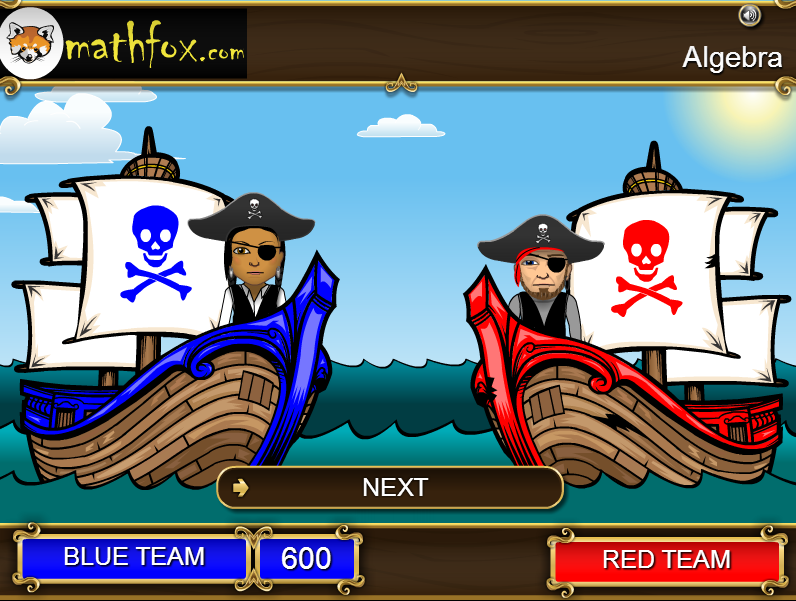
While searching online for different resources and games I came across one which stood out to me. The game was taken from the website MathFox which provides a variety of interactive online games for students varying in age, grade and skill level. The one which I selected dealt with algebraic expressions however presented very basic questions at the beginning. Each time a question was rewarded correctly students gained one hundred points and had the opportunity to “attack” the fellow pirate ship. This game would be ideal for students in the grade 4/5 level or those who struggle to grasp the fundamental elements of what algebra entails. I really enjoyed this game as I did not feel rushed nor pressed to finish a question within a certain time frame, I had a chance to think about what was being asked of me and to confirm my answer.  Games become an integral component to ensuring academic success and growth within students as they strengthen their skills by demonstrating problems in a “fun” way.

As a student my greatest struggle with mathematics was creating and solving algebraic expressions. It was something I was not familiar with, and often found it difficult to find the relationship between two dissimilar numbers. Through my own personal experiences, the readings provided as well our classroom discussion I have learned and better understood the importance of teaching students the “basic” skills of patterning in order to improve their understanding of algebra. If students do not have ab understanding of the preliminary skills it is illogical to expect them to understand the more complex, complicated units. 

Saturday, 24 October 2015

Week #6 Reflection

This week in our mathematics class we furthered our investigation on the topic of ratios, rates and proportions. To begin we were given different questions which we worked on independently and then reconvened as a group to discuss different ideas produced and thoughts generated. This is a great technique for instructing as it gives enough room for both independent work and group discussion. We continued our lesson by looking at the how rational proportions are similar to fractions in that they are used to compare or relate numerical values that are equal to one another. Similar to fractions this unit presents numbers in an unfamiliar for many individuals therefore it is important that educators take the time to provide students with a variety of methods to compute and understand what is being taught. To benefit the greatest amount from a lesson an educator must make a lesson practical and relatable for their students. When a student feels that what they are learning is beneficial towards their everyday life they are more likely to succeed and be inspired to learn.

This idea was demonstrated in our lesson when we were introduced to “Joels Kitten Problem”. This activity required individuals to work together in groups of two to four and come up with our own method to solve the problem. As a group we were responsible to solve the question and write out our steps with clear details on a piece of chart paper. When this was complete we joined up with a new group were we were responsible to instruct others on what we had done and communicate our way of interpretation and thinking. The benefit of this question was that it was open ended, it allowed for a variety of unique solutions and thinking techniques, as there was not a definite way to produce an answer. This method of teaching was informative as it was fascinating to observe the variety of thinking techniques. For example my group solved the problem through trial and error whereas the group we partnered up used fractions (Figure 1). Although our techniques were completely different, we both came up with the same conclusive answer. I thoroughly enjoyed participating in this exercise as listening, explaining and communicating with fellow peers not only strengthened my knowledge but expanded my overall understanding of the lesson.  As a future educator I anticipate including this technique in my classroom as I feel that students learn best from one another and benefit when they are put in an instructional position.

In my prior blog post I discussed the importance of including interactive, educational games into a lesson in order to satisfy the twenty first century practice of learning.  This week I explored the resources provided by our professor however continued to explore the outlet as I wanted to see what else the website offered for users. One game which I found particularly interesting was “Ratio Blaster” (Figure 2) an interactive game which worked to enhance students understanding of rational equations. Users are given one minute to complete as many equations as possible in order to proceed to the next level.  When a question is answered correctly the ships you are shooting at remain still however answered incorrectly the spaceships move closer to your shooter. The equations were not complex and when answered incorrectly, the correct answer was demonstrated. Unlike the resource “Orbit Integers” I explored last week this game was not a race, which may be beneficial for students who cannot handle a more fast paced game as well when a question was answered incorrectly a new solution was not produced instead the same question was asked which allowed individuals to fix their wrongdoings. As twenty first century educators it is our responsibly to introduce students to the abundant amount of resources available to them. We must take the time to discover different resources as they will have numerous benefits within a classroom.  

Figure 1
A screenshot of my group and a peers group solution to the question presented in class. Both solutions demonstrate a wide range of thinking however the final answers produced are similar.
Figure 2
A screen shot of "Ratio Blasters" users aim to "shoot" the correct answer for the question provided. The space ships lower when a question is answered incorrectly until they reach the users blaster.


Link to "Ratio Blasters"
http://www.mathplayground.com/ASB_RatioBlaster.html

Wednesday, 14 October 2015

Week #5 Reflection

This week in our mathematics class we continued our discussion on the complexity of understanding fractions from both an educator and student perspective. As an educator it is our responsibility to ensure students are confident and comfortable when learning new concepts. We must create an inclusive learning environment where students are welcomed to ask questions and challenge their skills. In this lesson we also focused on the concept of integers and how similar to fractions they present numbers in a new, unfamiliar way for many individuals. From my own personal experience as a student the most difficult component of learning integers had to be memorizing the different rules. When educators expect students to learn through memorization they are depriving them of their ability to expand their understanding. Students retain information in a multitude of ways therefore educators should not expect uniformity in comprehension as it decreases the opportunity for individual growth. Another integral component for student success is applying concepts to realistic, everyday situations. When a connection between academic knowledge and reality is established individuals are more likely to become familiar and comfortable with what they are learning. This idea proves relevance in mathematics, especially dealing with units in fractions and integers. The video “Math Interactive” (link below) provided by our professor supports this idea. This video introduces integers in an informative manner by demonstrating how they relate to the measuring of increasing and decreasing temperatures. For students I feel a video such as this one would be beneficial as it introduces integers in a “non-threatening” manner which is fundamental when developing a base understanding. 

Through the years math continues to be given a negative connotation due to its complex nature. As a result educators must find a way to teach in both an informative and entertaining way. This can be done in a variety of ways, but for me the most influential technique to accomplish this is through games. The online game “Orbit Integers” (link below) provided by our professor is an interactive game where students go online to race against others by completing a variety of mathematical equations. This game requires fast thinking and a good understanding of adding together both positive and negative numbers. The game takes place in outer space where students take the form of a space ship. They are given a variety of equations and when they successfully complete a question they move forward towards the finish line. In the article Video Games in the Classroom Building Skills in Literacy and Numeracy (link provided below) the author prompts the idea of the incorporation of interactive video games and computer simulators in the contemporary classroom as studies have demonstrated that these outlets may be able to offer students interesting and informative context for learning. They hypothesize that the high tech graphics, sounds and motions allow participants to become active learners as they realize that their actions create a reaction allowing their level of interest to increase. The twenty first contemporary society has transformed into one dependent on technology thus educators must be willing to adapt these changes and introduce them into their classrooms to increase student success. When students feel as if they are being challenged their level of interest and motivation will likely increase therefore a game such as this one may aid in the development of individual growth and understanding of integer operations. The only negative element of the game is the nervousness which may be felt by a student when playing. It is a fast paced game which requires quick thinking and fine motor skills therefore if a student does not have a thorough understanding they may feel over whelmed. The game is fantastic as not only does it give users a challenge but it informs users of where they went wrong.

Screen shot of "Orbit Integers". Users are ranked based on the completion of the number of correct answers, as well their recorded time. As well users are shown the accuracy rate and if any questions where missed. 

Link to “Math Interactive” 
http://www.learnalberta.ca/content/mejhm/index.html ID1=AB.MATH.JR.NUMB&ID2=AB.MATH.JR.NUMB.INTE&lesson=html/video_interactives/integers/integersSmall.html

Link to "Orbit Integers" 
http://www.arcademics.com/games/orbit-integers/orbit-integers.html

Link to Video Games in the Classroom Building Skills in Literacy and Numeracy:
http://www.edugains.ca/newsite/literacy/resource_by_topic.html

Saturday, 3 October 2015

Week #4 Reflection

Reflection:

This week we had the opportunity to explore fractions and the difficulty to comprehend  different concepts from both a student and educator position. Fractions present numbers in a new and peculiar way, a form which many individuals may not be familiar or comfortable with. In addition, students are expected to add, subtract, multiply and divide these “odd” numbers together to create a “new” fraction, which I am sure you can imagine how complex and confusing it may be for a new or learner. Even as a future educator, I continue to be uneasy and often perplexed when looking at different fraction equations. This week, we divulged into the issue of nervousness felt by both teachers and students. We also discussed the importance of having both the confidence in ourselves to lead a lesson, while acknowledging that, just like our students, we will make mistakes. To succeed and grow in math we must accept that we are not perfect and realize that it is through our mistakes that we foster our growth as an educator. This lesson has been the most informative and relateable so far, as I feel that encouraging and accepting our mistakes was once something frowned up and condemned. This token of knowledge will become useful in my educational activities studies, as it reminds me that I am not a robot, and if I do make a mistake it will not be the end of the world.

Similar to many mathematical concepts, fractions can be taught in a multitude of different ways. As discussed in my previous blog entries, educators must be willing to expand their horizons when instructing a lesson. This idea is relevant when dealing with fractions as they can such a confusing concept for many students. When we help our students explore their own understanding, we assist them in fostering their intellectual expansion. Another valuable lesson enhanced this week was the importance of including a multitude of manipulators for students. Manipulators allow individuals to visualize and physically work out an equation which they may find to be problematic. An example is shown by the fraction tile sheet (Figure 1) which demonstrates how smaller divisions of a number make up a whole and illustrates which fractions are greater/less than others. For example, when adding together two dissimilar fractions 1/4 + 1/2 one student may find it easier to find a common denominator, and then add together the numerators:

1/4 + 1/2 *4 is the common denominator so you multiple 1/2 by two to get 2/4 so the equation becomes 1/4 + 2/4 which produces 3/4. Some students may be unable to understand this concept and instead use a fraction tile sheet, or a fraction pie sheet (Figure 2) to visually see how the equation works. To conclude, an educator must not limit their student’s exploration of knowledge but instead encourage their exploration of different methods and techniques.

Fractions are concepts which we cannot live without as they are something we encounter on a regular basis therefore, we must continually strengthen and expand our knowledge. A valuable resource I came across can be accessed through the link provided below. The website found in the link below provides a variety of definitions for different equations. It also provides simple and more complicated activities for both beginner and advanced learners. As well, if users make a mistake the website provides an explanation and advice on how to correct it. 
Figure 1                              Figure 2
 
www.rainbowresource.com                            www. learnfractions.wordpress.com/

See link below:
http://www.bgfl.org/bgfl/custom/resources_ftp/client_ftp/ks2/maths/fractions/